Technology
Large Medical Model
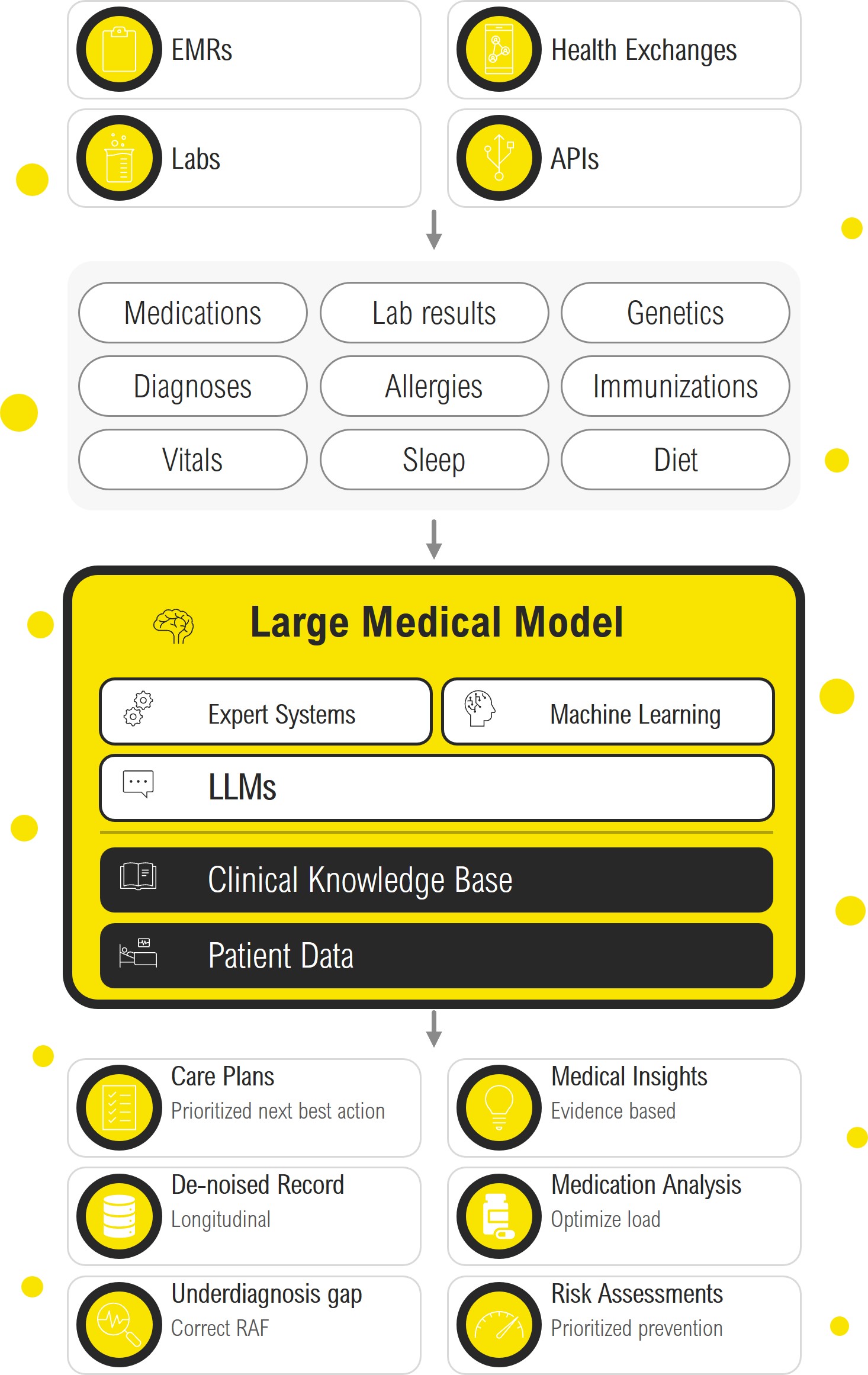
uMETHOD’s Large Medical Model is built on a broad and diverse base of medical knowledge. It combines conventional AI algorithms with large language models to process a patient’s full medical history and lab results, producing Next Best Medical Actions. These are specific, evidence-linked recommendations a physician evaluates when deciding on a treatment plan for complex patients.
A Large Medical Model is not a Large Language Model
This distinction matters because the world has learned to equate “AI” with chatbots. A large language model is trained to predict language: it learns from text and returns text. That makes it impressive at summarizing, drafting, and explaining. The same fact makes it unsuited to deciding what should happen to a specific patient. Fluency is not correctness, and the same clinical facts, worded differently, can lead it somewhere different.
uMETHOD’s Large Medical Model is built to reason about the whole patient across fragmented care. Patients see multiple physicians and specialists, each treating different problems, while the reasoning behind diagnoses, medications, and treatment decisions is often lost as information moves among them. Its input is the patient’s medical data, beginning with current lab results; its knowledge base is curated medical evidence, not the open internet; and its engine combines deterministic clinical logic, interaction checking, and optimization across competing objectives, with language models used for narrowly defined inference tasks, such as determining why a medication is being taken when the record no longer preserves that rationale. Its output is not an essay, but discrete Next Best Medical Actions, each traceable to the specific patient data and medical knowledge that produced it.
Put simply: a large language model is a brilliant generalist who has read almost everything and remembers the shape of it. A Large Medical Model has the patient’s actual file open and reasons across it as a whole — checking every drug against every other drug, every condition against every treatment, and every lab trend against the rest of the patient’s history — while attaching evidence to each recommendation it makes. We use language models inside that system as governed components, not as the system itself.
Built for patients no chart can summarize
We focus on the hardest cases in medicine: people taking ten or more medications, living with several interacting chronic conditions, whose records span multiple health systems and decades. Complexity of this kind does not grow one item at a time; it multiplies. Each new medication, diagnosis, or lab trend can interact with anything already in the record. Genomic, biomarker, imaging, and longitudinal data add still more dimensions. That multiplication outruns the time any clinician can give it.
Consistent, and able to show its work
The same patient data, processed under the same version of our medical knowledge, produces the same Next Best Medical Actions. For every result, the system can report what data it received, which version of our medical knowledge was in force, and which piece of that knowledge produced each recommendation. Where language models contribute, their output is validated against our medical knowledge before it can affect a recommendation — which is part of what keeps the whole system reproducible.
Validated in production
- More than 25,000 highly complex patients served in real clinics
- Four peer-reviewed journal articles documenting improved clinical outcomes, with more in process
- Integrated into EMRs and clinical workflows
- Four issued patents covering AI-derived care planning for cognitive impairment and dementia
Strong patent position in dementia care
Our four issued patents cover the application of algorithms and systems to determining care plans for cognitive impairment, dementia, and Alzheimer’s disease. They claim the central method: deriving an individualized, evidence-based plan of action from a complex patient’s medical data. Taken together, they represent a substantial body of issued intellectual property in the application of AI to dementia treatment planning.
Beyond cognitive care
Because the Large Medical Model reasons across disease boundaries rather than within a single specialty, the same system applies to Parkinson’s disease, depression, diabetes, and chronic disease management generally — as well as to medication optimization and surgical prehabilitation. Partners are not adopting one therapeutic segment; they gain clinical reasoning infrastructure that spans chronic disease.